In 1934, Gertrude Stein visited America for the first time in over two decades. No longer the failed medical student and confused young woman she had been when she left in 1903, she was a renowned author invited to give lectures nationwide. During this tour, organized upon the publication of her popular memoir The Autobiography of Alice B. Toklas, she was also invited to numerous social events–including the carefully scheduled one-day pit stop she made in Chicago to see the opera Four Saints in Three Acts, which she wrote and for which her friend Virgil Thompson composed the music. The performance featured the critically acclaimed original Broadway cast from earlier that year—notably, an all-Black cast. This November night marked the only time Stein would see her opera performed, since she missed its premiere in Hartford, Connecticut, and its run on Broadway.
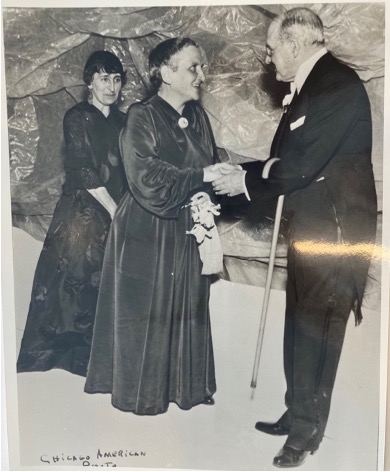
A research photo from the Robert A. Wilson collection shows this night as Stein and Alice B. Toklas prepare to head into the theater and experience the show. Stein is shaking hands with Harold McCormick, a wealthy businessman and prominent donor to the Chicago Opera. In the lower-left corner of the original photograph is a handwritten annotation, partially obscured in this copy, that identifies the owner of the photo as the Chicago American newspaper. It seems likely, therefore, that this particular photo was taken by an unnamed journalist working for the Chicago American and that it was published in that newspaper alongside the review of the performance and report from the evening. Photographs of Stein and Toklas were often printed in local newspapers as they toured America and undoubtedly many photographers were there that night to capture the elites in their finery. As the Chicago American newspaper from 1934 is not accessible digitally, I cannot look for the article that may have been published with this photograph, but it is probable that the coverage echoed that of other papers who documented the night as a high society event. A reporter for the Chicago Daily Tribune expressed the excitement leading up to the night, for example, “[W]e go in best feathers to hear her opera Wednesday night at the Auditorium. Pigeons in the grass. Indeed!” (Cousin 1934.)
Considering the context in which this photo would have been taken and published further explains the framing and the importance of the whole body shot. Following these high society events, local newspapers often published full body images of the women and their evening fashion, including the review from this opera where five women were photographed and shown alongside the article in the Chicago Daily Tribune. By capturing this photo, the photographer and journalist were able to create a conversation on the pair of pairs fashion. In doing so, Stein was brought into the fashion discourse and provided another angle for readers to live vicariously through during the sparsity of the Great Depression. Stein was described alongside other women as wearing a “long-sleeved, high-necked gown of a dark plum color” that “completely overshadowed the colorful and gorgeous gowns of her feminine neighbors” (Moffett 1934). She was the ‘center of attention,’ but the author also separated her from the more feminine attendees, including Alice B. Toklas.

The fact that Stein is shown shaking hands with Chicago’s well-to-do businessman McCormick offers another insight into the newspaper’s representation of the evening. McCormick was the son of Cyrus McCormick, the inventor of a revolutionary farming reaper whose net worth was estimated at well over $10 million after his death (Rodkin 2007). The younger McCormick was a generous donor to the Chicago Opera, and his philanthropy only increased after he married his second wife, Ganna Walska, an opera singer. Why did the Chicago American photographer focus on the handshake with him and not another prominent local figure of the night? Mrs. Bobsy Goodspeed, a wealthy socialite and President of the Arts Club who was married to a trustee of the University of Chicago, had specifically invited Stein and Toklas; they were being guided through America on this leg of their adventure by Carl Van Vechten, a well-known writer and alum of the University of Chicago. By focusing on McCormick, the photo placed Stein and Toklas in the inner circle of the uber wealthy of Chicago society, not just its cultural elite. McCormick would inherit his family company the next year and was at the time one of the wealthiest men in Chicago. Of course, the decision to publish this particular photograph was made by the newspaper, not Stein, we do not know if she would have wanted to publicize a photo with McCormick. Whether she would have wanted it or not, she is shown just before the opening of a long-anticipated production of her only opera shaking hands with McCormick.
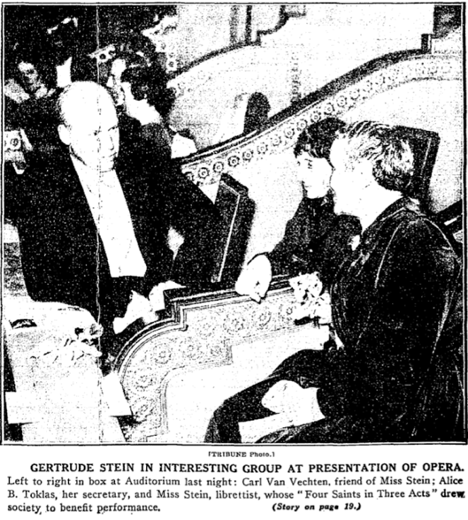
This night at the opera is recorded in multiple newspapers, but this image shows Stein and Toklas just before they see a once-in-a-lifetime achievement for Stein. Both women are beaming after traveling all day to make the performance and are shaking hands with Harold McCormick and being introduced to doubtless dozens of others as Chicago’s Upper sect took the opportunity for an early glimpse of Stein before she returned in a few weeks on her lecture tour and see how she compared to the articles published leading up to her arrival.
Bibliography
Cass, Judith. 1934. “Society Will Attend Stein Opera Tonight: Premiere to be Benefit for Vocational Society.” Chicago Daily Tribune (1923-1963), Nov 07, 19. https://www.proquest.com/historical-newspapers/society-will-attend-stein-opera-tonight/docview/181598927/se-2.
Cousin, Eve. “Society Busy with Lectures and Luncheons: Gold Lace and Decorations Attend Sponsors’ Farewell to World’s Fair.” Chicago Daily Tribune (1923-1963),Nov 04, 1934. https://www.proquest.com/historical-newspapers/society-busy-with-lectures-luncheons/docview/181609824/se-2.
“Display Ad 49 — no Title.” Chicago Daily Tribune (1923-1963), Oct 07, 1934. https://www.proquest.com/historical-newspapers/display-ad-49-no-title/docview/181598550/se-2.
“Gertrude Stein, American Writer, Speaks and Reads from Her Libretto for Opera HD Stock Footage.” CriticalPast, 1934, https://www.youtube.com/watch?v=TtV6f6ZIFdE. Accessed 19 Sept. 2023.
Moffett, India. 1934. “Audience Eyes a Simple Gown at Stein Opera: Author and Society Like New Work.” Chicago Daily Tribune (1923-1963), Nov 08, 19. https://www.proquest.com/historical-newspapers/audience-eyes-simple-gown-at-stein-opera/docview/181568214/se-2.
Moore, Edward. 1934. “Leave Common Sense at Home and You can Enjoy this Opera.” Chicago Daily Tribune (1923-1963), Nov 08, 19. https://www.proquest.com/historical-newspapers/leave-common-sense-at-home-you-can-enjoy-this/docview/181582792/se-2.
Photographs of Gertrude Stein and others, 1874 – 1934, Box: 2, Folder: 3; Box: 12, Folder: 1. Robert A. Wilson collection of Gertrude Stein materials, MS-0785. Special Collections.
Rodkin, Dennis. “The Richest Chicagoans of All Time.” Chicago Magazine, 16 Aug. 2007, http://www.chicagomag.com/chicago-magazine/april-2006/the-richest-chicagoans-of-all-time/.
“Virgil Thomson and Luciano Chessa’s Four Saints in Three Acts with Opera Parallèle.” YouTube, 29 Nov. 2012, youtu.be/YrneAej8rh4?si=DMc4lb-9638Q8ITE.
 CURATING GERTRUDE STEIN