
Interesting insights into Gertrude Stein’s life and later reception are apparent in five carbon copies of letters Mabel Foote Weeks wrote to Stein between 1901 and 1920. Weeks met Stein when the two attended Radcliffe College (then called the Harvard Annex). Though Weeks graduated in 1894, she and Stein kept in touch after Stein moved to Baltimore to begin studies at Johns Hopkins University in 1897. The two still met outside of their letters, notably spending the summer of 1900 together in Europe a few years before Stein moved permanently to Paris. The carbon copies in question are part of the Robert A. Wilson Collection of Gertrude Stein Materials.
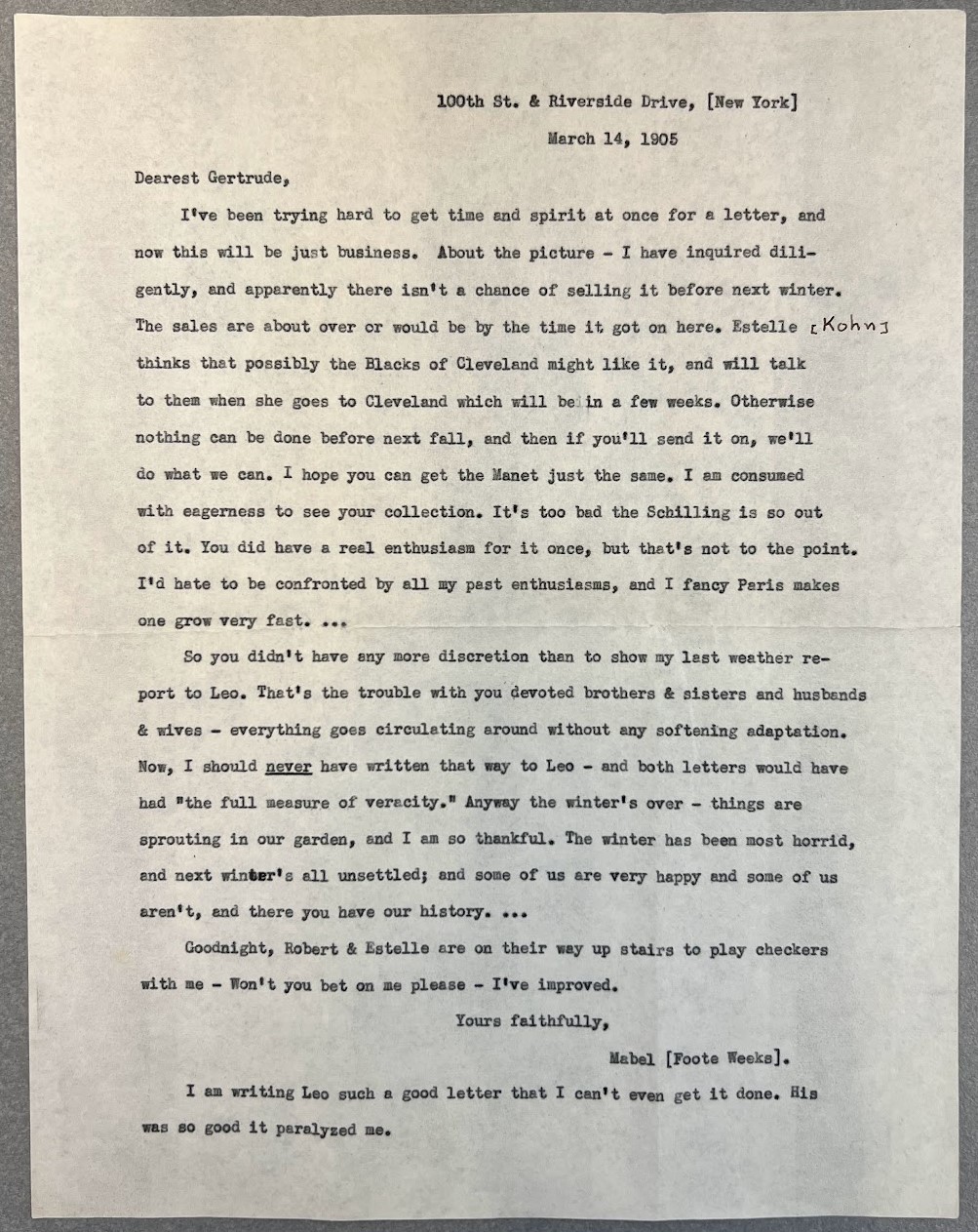
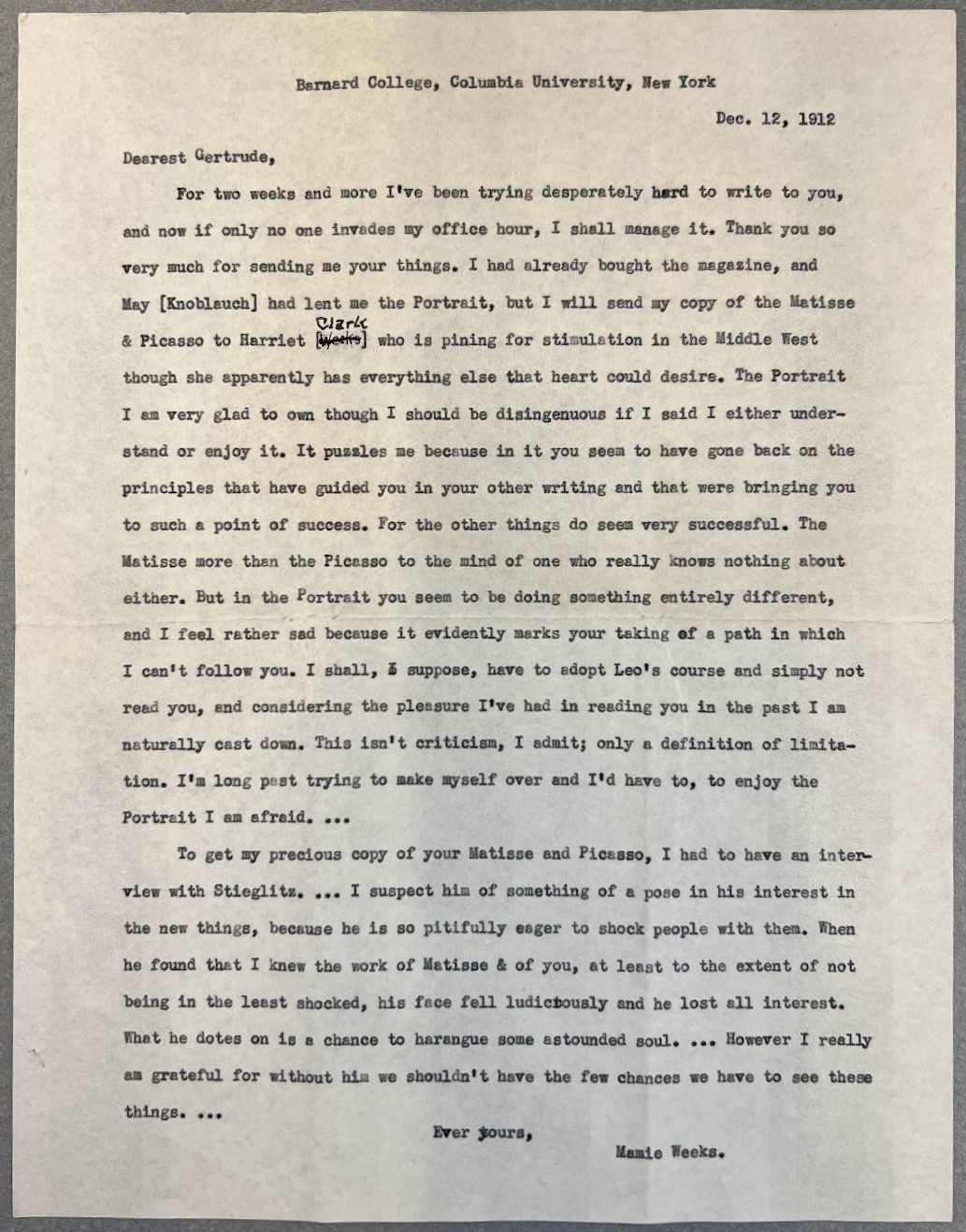
Though these letters are addressed to Stein, supplemental information included implies that these were typed not by Weeks, but were instead transcribed to prepare for The Flowers of Friendship: Letters Written to Gertrude Stein, edited by Donald Gallup and published by Alfred A. Knopf in 1953. One clue to this is the inclusion of added last names for mutual friends of Stein and Weeks such as “May [Knoblach]” or “Estelle [Kohn]”. It is also significant that these notes were made by hand, as it is unlikely that either Stein or Weeks would need to specify the surnames of familiar friends. Perhaps these copies of the letters were typed by Donald Gallup, the editor of the book, though it is possible that somebody else had assisted with this process.
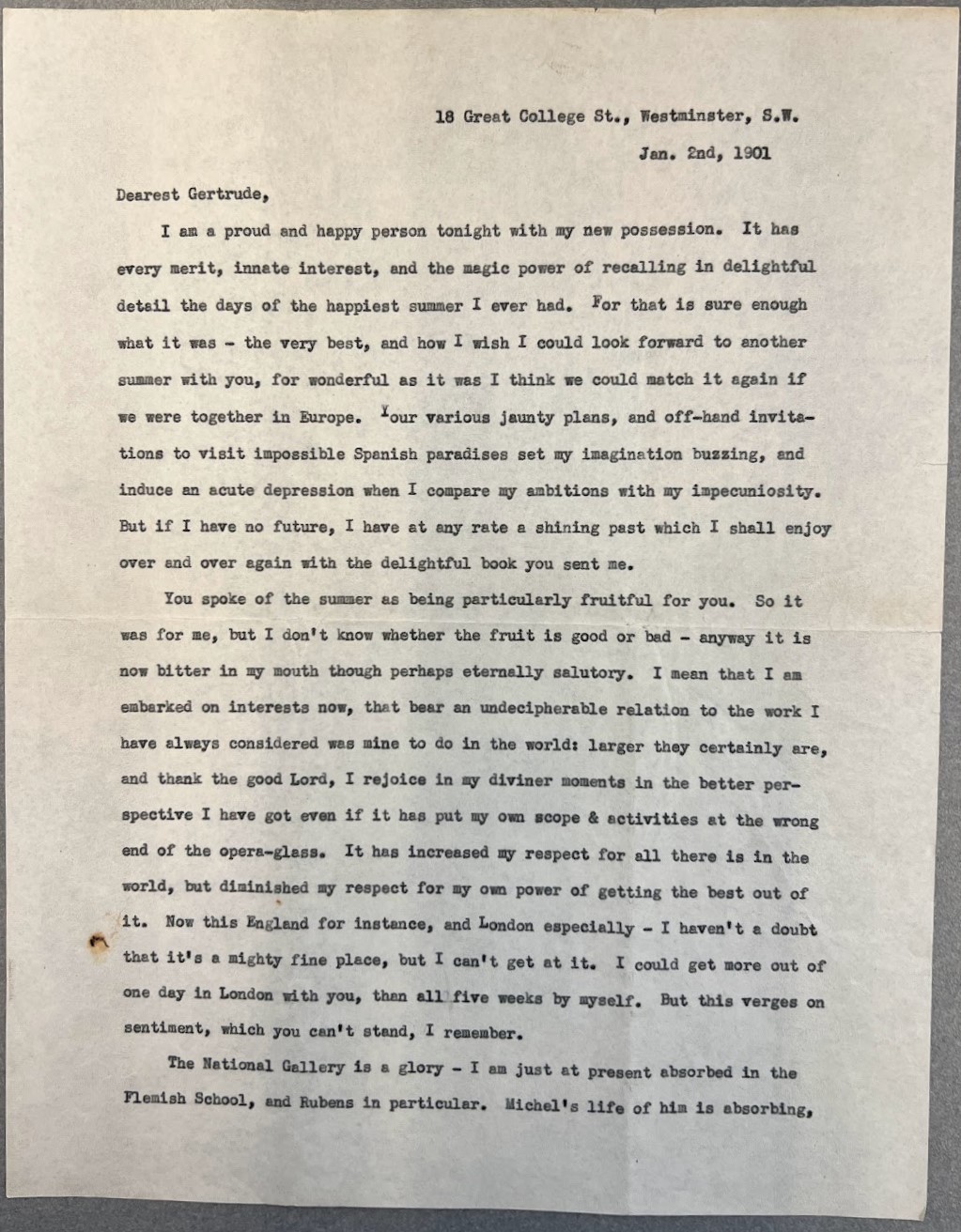
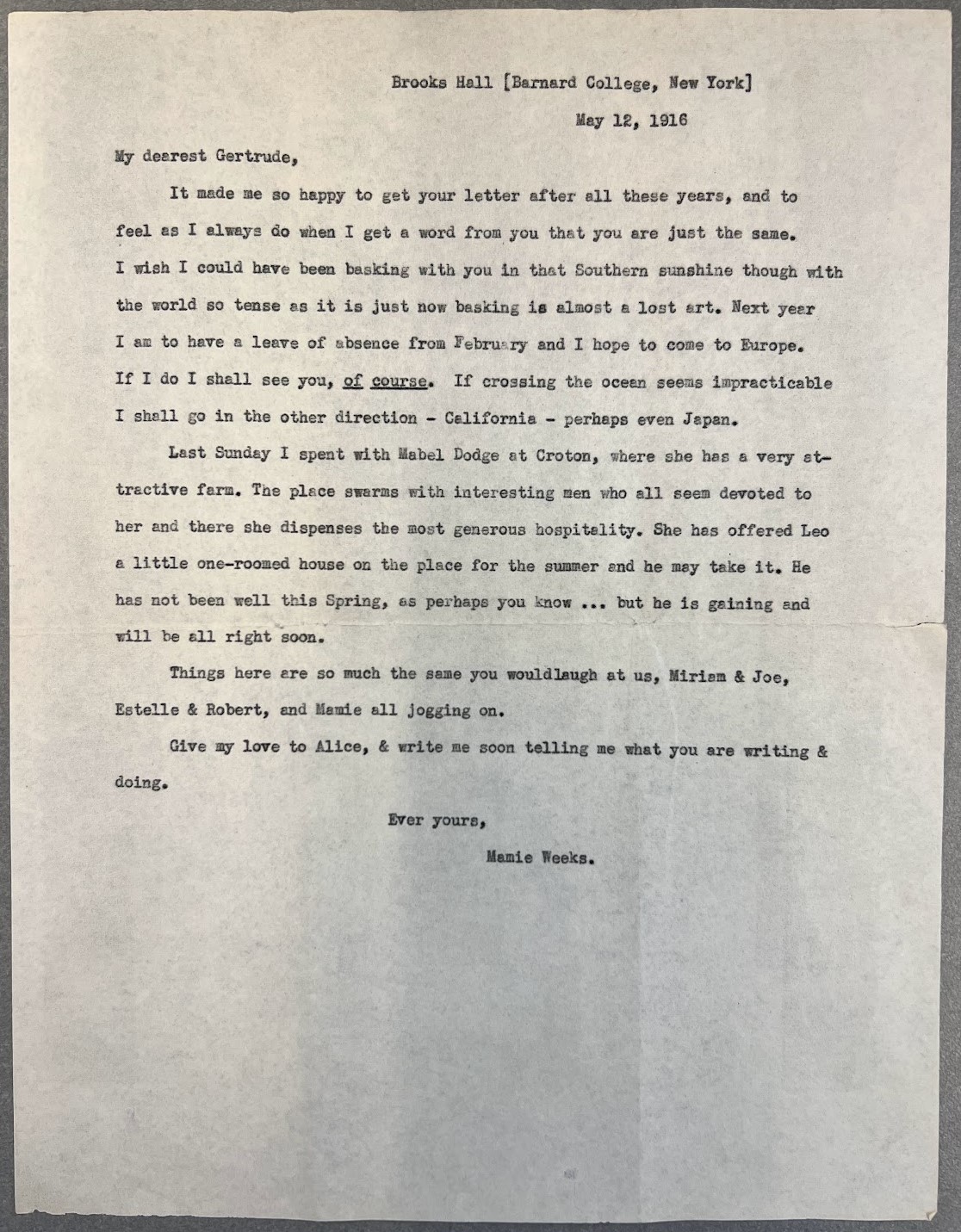
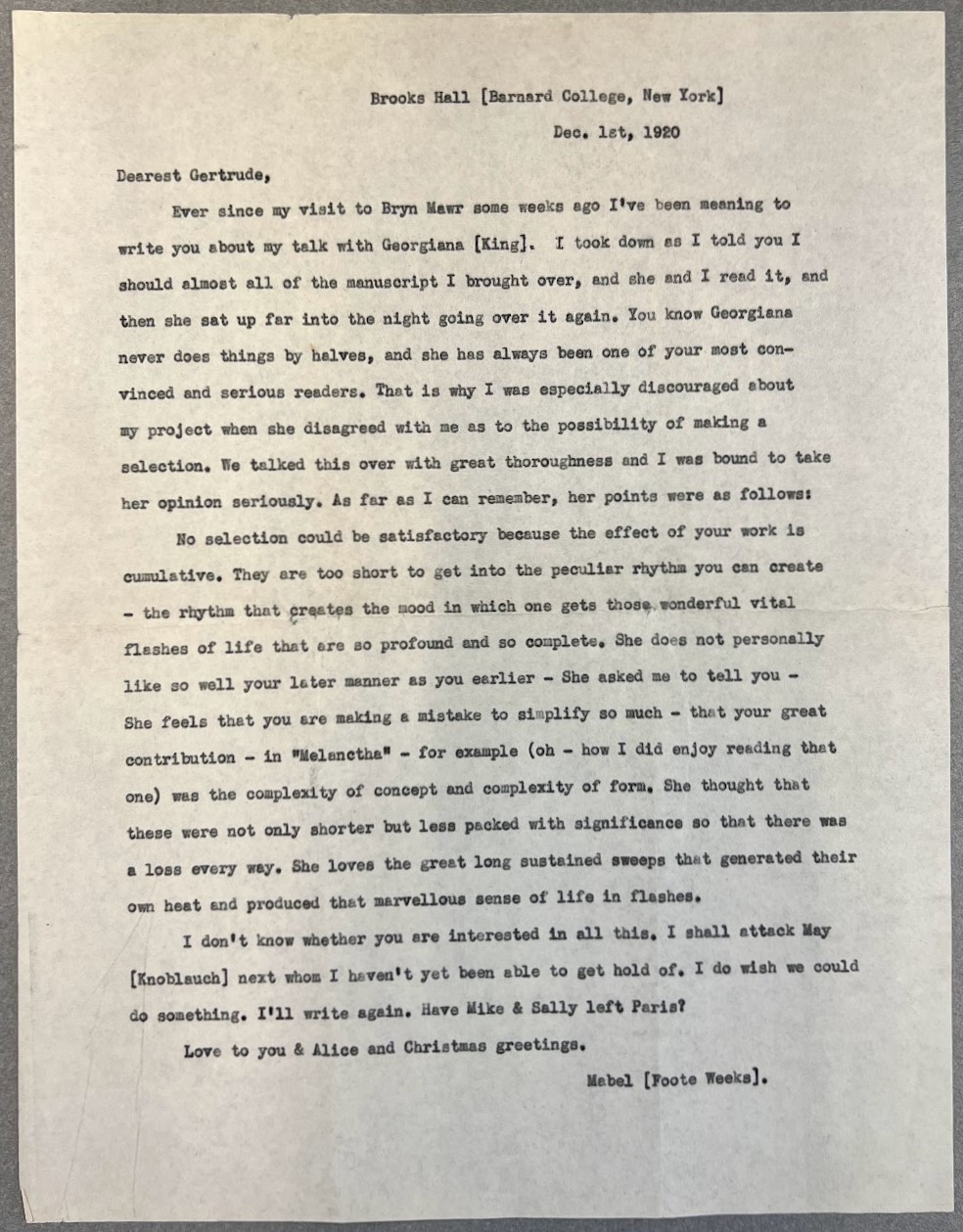
The letters are dated 1/2/1901, 3/14/1905, 12/12/1912, 5/12/1916, and 12/1/1920. As these are typed transcriptions, it is unclear if this date was included in the original letter or if they were obtained from postmarks. We should also consider that these transcripts were likely prepared while Gallup was compiling sources for his book, sometime before it was published. Although the Wilson collection includes carbon copies of five letters from Weeks, only three of them ( 1/2/1901, 3/14/1905, and 12/12/1912) were published in the book.
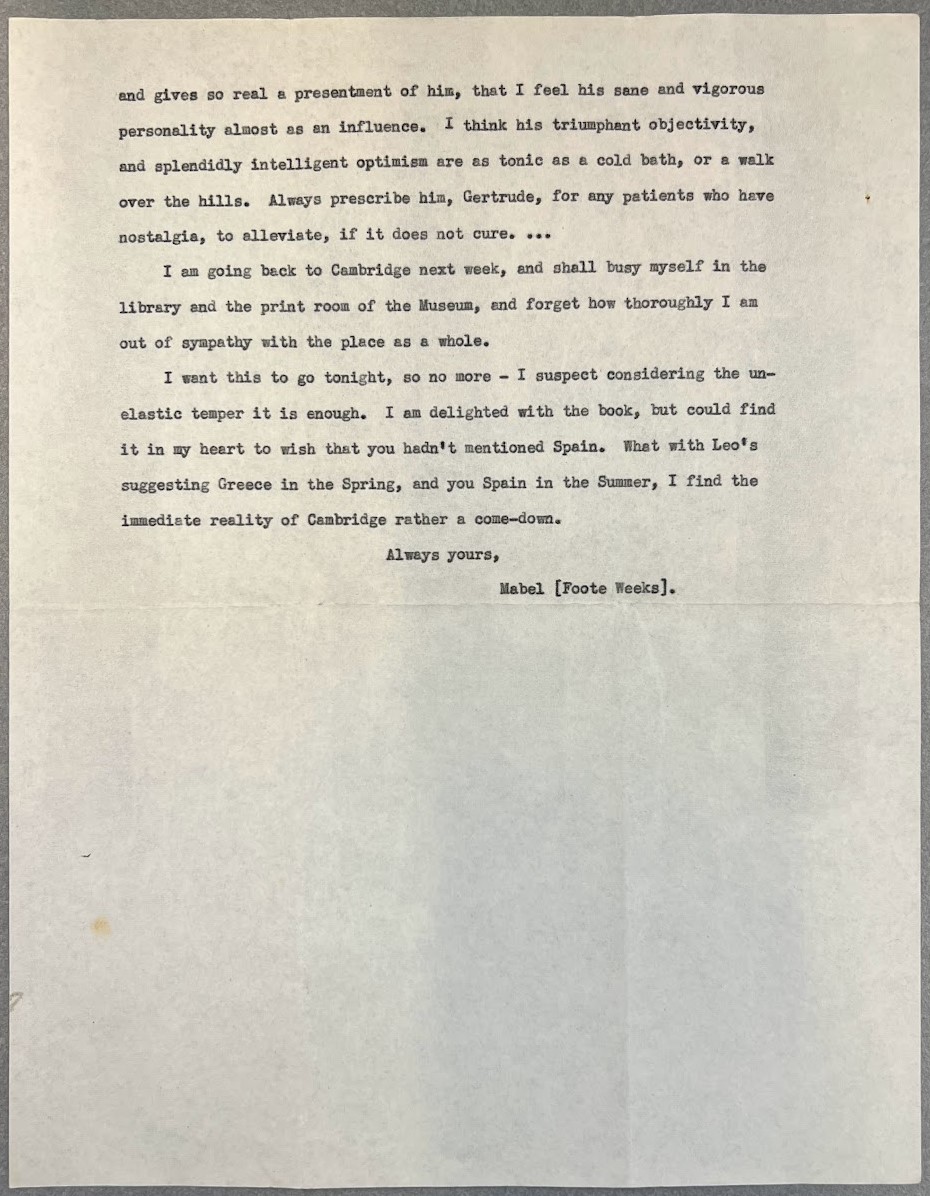
While at first glance these letters may seem to be simple typescripts, closer examination reveals that they are carbon copies of typescripts. The paper is delicate, a lighter weight than what was usually used in typewriters, and there are faint lines along the margins marking where the carbon has transferred onto the page. Additionally, the creases on the paper suggest that at some point all of the letters were folded thrice (once horizontally, twice vertically). These creases could imply that these copies of the letters were mailed in standard envelopes, or maybe that they were folded for easier transportation or storage before entering the collection. There is also a stain on the 1/2/1901 letter, more prominent on the first page but also visible on the second, though it is unclear what caused the mark.
What is interesting about this collection of letters is that though we are only getting one side of the exchange, we can infer much about Stein’s life at these checkpoints. Starting with 1/2/1901, we hear about the summer Stein and Weeks vacationed together and of Stein’s insistence for Weeks to visit her in Europe again. We are able to learn so much about Stein’s personality through just two sentences as Weeks writes: “I could get more out of a day in London with you, than all five weeks by myself. But this verges on sentiment, which you can’t stand, I remember.” In the 3/14/1905 letter, we can see how far Stein’s art collection has come since the first letter, as well as gauge the closeness of Weeks and Leo Stein’s relationship. Though the letter does not offer specifics, it seems clear that Weeks has separate friendships with the siblings and was surprised to hear of the gossip they occupy themselves with, at one point making a remark about Gertrude and Leo discussing the contents of their correspondences with Weeks without her knowing. The 12/12/1912 letter discusses Weeks’s involvement in Stein’s writing and her reactions to stylistic changes in Stein’s works. The 5/12/1916 letter reveals that Stein and Weeks hadn’t kept in touch as regularly since the 1912 letter, and focuses mostly on Weeks. Finally, the 12/1/1920 letter once again gives insight into how important Stein’s personal connections were to the editing and publishing processes for her works. The scope of these friendships is impressive, especially considering that Weeks spent most of her time in the United States while Stein remained in Paris. This was, however, important for Stein to be able to pursue publishing options in the United States. Friends such as Weeks served as representatives for Stein to search for publishers and distribute her works.
Overall, it is quite fitting that Gallup’s book was titled The Flowers of Friendship as these letters demonstrate the fruitful exchanges between Weeks and Stein throughout the decades of their friendship. Weeks filled an important position in Stein’s life, being both an interlocutor and a trusted reader of her works. As this was one of Stein’s older friendships, Weeks was able to understand the contexts of Stein’s works such as Three Lives, as she was present for the events in Stein’s life that influenced these works. These letters were published around the time that Yale was publishing Stein’s unpublished writings and help demonstrate how the reception of Stein, both by the public and by her friends, is inseparable from her legacy.
The Letters
Libraries, Johns Hopkins University. Photograph by Joelie Garcia.
Works Cited
Mellow, James Robert, and Robert A. (Robert Alfred) Wilson. Charmed Circle : Gertrude Stein and Company. London: Phaidon Press, 1974. Print.
Souhami, Diana. Gertrude and Alice. London: Pandora, 1991. Print.
 CURATING GERTRUDE STEIN